10 Worst Football Injuries Ever Caught on Camera (Some Are Hard to Watch)
Discover the worst football injuries ever — shocking leg breaks, career-ending moments, and tragic incidents that left fans speechless. Some are hard to watch.
 alissaperry
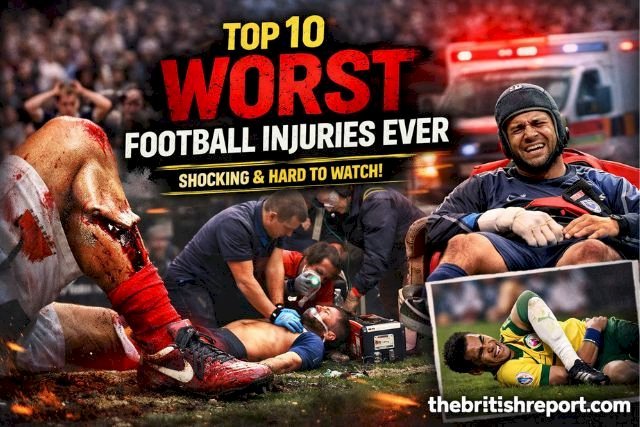
Football is called the beautiful game — but sometimes, it turns terrifying in seconds.
From legs snapping in brutal tackles to players collapsing on the pitch, some moments in football history are so shocking that fans still can’t watch them again.
In this article, we break down the worst football injuries ever recorded, including incidents involving Aaron Ramsey, Petr Čech, and Neymar — moments that changed careers, rules, and the sport itself forever.
Some of these injuries are truly disturbing.
Quick List: Worst Football Injuries Ever
- Marc-Vivien Foé – On-field death (2003)
- Neymar – Back fracture (2014)
- Fabrice Muamba – Cardiac arrest (2012)
- David Busst – Career-ending leg break (1996)
- Eduardo da Silva – Open leg fracture (2008)
The Science Behind Severe Football Injuries
Modern sports science has helped explain why some football injuries are far more devastating than others. High-speed motion, sudden deceleration, and rotational force place extreme stress on bones, ligaments, and joints — especially the knees, ankles, and spine. According to sports medicine research, the combination of speed and body weight during a collision can generate forces comparable to a low-speed car crash.
This is why many of the worst football injuries occur during seemingly routine challenges. A mistimed tackle, awkward landing, or late collision can overload the body’s natural limits in milliseconds, resulting in compound fractures, ligament ruptures, or neurological trauma. Understanding these mechanics has helped clubs redesign training, recovery schedules, and injury-prevention programs.
Why the Worst Football Injuries Happen
Football’s speed and physicality make injuries almost inevitable. Every match features high-speed sprints, sliding tackles, and collisions that test the limits of the human body.
The worst football injuries usually occur due to:
-
High-impact tackles that cause bone fractures.
-
Overexertion leading to ligament or muscle tears.
-
Accidental collisions resulting in head or spinal trauma.
Even with improved training, technology, and refereeing, football remains a contact sport — one where a single misstep can end a career.
How These Injuries Were Ranked
The following list is based on:
-
Severity and shock factor
-
Career impact and recovery time
-
Emotional response from fans and teammates
-
Lasting influence on football safety protocols
These aren’t just injuries — they’re turning points in football history.
Injury Statistics: How Common Are Severe Football Injuries?
While the worst football injuries capture headlines, data shows how rare — yet serious — they truly are. According to research on European football injuries, professional players sustain an average of 8 injuries per 1,000 match hours. However, catastrophic injuries such as compound fractures or cardiac incidents account for less than 1% of total cases.
Lower limb injuries — especially ACL tears and tibia fractures — remain the most common severe injuries in elite football. Medical experts note that match intensity has increased by nearly 30% over the past two decades, contributing to greater stress on players’ joints and muscles.
This statistical perspective highlights why the worst football injuries stand out: they are rare, but when they occur, they reshape careers and safety standards alike.
Before setting up your field, check out the official soccer goal size guide for every age and level to get it right.
10. Aaron Ramsey – 2010 Leg Break
Match: Stoke City vs Arsenal (February 2010)
Injury: Compound fracture of tibia and fibula
One of the worst football injuries in Premier League history happened when Ryan Shawcross’s tackle left Aaron Ramsey’s leg broken in two places. The young Welshman’s screams silenced the crowd, and even Shawcross left the field in tears.
Ramsey spent almost a year recovering but made a remarkable return, later becoming a hero at Arsenal. His story remains a symbol of courage and mental toughness after unimaginable pain.
9. Petr Čech – Skull Fracture (2006)
Match: Reading vs Chelsea (October 2006)
Injury: Depressed skull fracture
Petr Čech suffered one of the worst football injuries for a goalkeeper when Reading’s Stephen Hunt accidentally struck his head with a knee just seconds after kickoff.
Čech was rushed to the hospital and underwent emergency surgery. Doctors said he was lucky to survive. When he returned, he wore a padded helmet — now iconic — which changed football’s approach to head safety forever.
8. Eduardo da Silva – Leg Break (2008)
Match: Birmingham City vs Arsenal
Injury: Open fracture of the fibula and dislocation of the ankle
Eduardo da Silva’s injury remains one of the most disturbing moments in Premier League history. After a reckless tackle by Birmingham’s Martin Taylor, Eduardo’s leg bent horrifyingly — so graphic that broadcasters refused to show replays.
Though he made a comeback, he never fully recovered his confidence. His case remains a reference point whenever discussions arise about tackling safety and the consequences of the worst football injuries.
7. Djibril Cissé – Double Leg Breaks (2004 & 2006)
The French striker’s luck was cruel — he suffered not one, but two of the worst football injuries in just two years.
In 2004, while playing for Liverpool, his leg twisted under a defender’s weight. Two years later, during a friendly for France, another collision broke the same leg again. Doctors even feared amputation, but Cissé’s determination saw him return to top-flight football. His resilience became an inspiration to athletes worldwide.
6. Luc Nilis – Career-Ending Collision (2000)
Match: Aston Villa vs Ipswich Town
Injury: Double compound fracture
Luc Nilis, a gifted Belgian striker, suffered a horrific collision with Ipswich keeper Richard Wright that shattered his leg. It was one of the worst football injuries that instantly ended a career.
Despite successful surgeries, Nilis never played again. However, he later dedicated his life to coaching and mentoring, proving that while the injury ended his playing days, it didn’t end his love for the sport.
5. David Busst – Coventry vs Manchester United (1996)
Match: April 1996, Old Trafford
Injury: Compound fracture of tibia and fibula
David Busst’s leg injury is often cited as one of the worst football injuries ever seen live. His collision with Manchester United’s Denis Irwin and Brian McClair left his leg shattered and bone exposed.
Even hardened professionals couldn’t bear to look — Peter Schmeichel vomited on the pitch. Despite 26 surgeries, Busst never played again. His case became a grim reminder of football’s risks and sparked changes in defensive safety awareness.
4. Fabrice Muamba – Cardiac Arrest (2012)
Match: Bolton Wanderers vs Tottenham Hotspur
Injury: Sudden cardiac arrest
Fabrice Muamba’s collapse during a 2012 FA Cup match terrified the football world. His heart stopped for 78 minutes — a medical miracle that he survived.
This was not a typical injury but remains one of the worst football injuries in terms of severity and emotional impact. Muamba was forced to retire, but his story led to sweeping reforms in medical readiness, including defibrillators and trained medics at all stadiums.
3. Alf-Inge Håland – Roy Keane’s Infamous Tackle (2001)
Match: Manchester United vs Manchester City
Injury: Severe knee damage
Roy Keane’s revenge tackle on Alf-Inge Håland is infamous. It wasn’t just dangerous — it was intentional. Keane’s lunge caused major knee ligament damage, and Håland never fully recovered.
Years later, Keane admitted the foul in his autobiography, sparking outrage. The incident remains one of the most controversial and deliberate examples among the worst football injuries in the modern era.
2. Neymar Jr. – World Cup Back Fracture (2014)
Match: Brazil vs Colombia (World Cup Quarter-Final)
Injury: Fractured vertebra
Neymar’s 2014 injury broke more than just a bone — it broke Brazil’s heart. A knee to the spine from Colombia’s Juan Zúñiga fractured his vertebra, leaving him writhing in pain and out of the tournament.
His absence was felt instantly as Brazil fell 7–1 to Germany in the semifinals. Among the worst football injuries of the 2010s, Neymar’s is remembered for its emotional impact on both player and nation.
1. Marc-Vivien Foé – On-Field Death (2003)
Match: Cameroon vs Colombia (Confederations Cup)
Injury: Cardiac arrest (hypertrophic cardiomyopathy)
Marc-Vivien Foé’s sudden collapse on the pitch during the 2003 Confederations Cup remains football’s most heartbreaking moment. Despite immediate medical attention, he tragically passed away from an undiagnosed heart condition.
It’s widely regarded as the worst football injury ever — not just because of its finality, but because it changed the game forever. FIFA implemented compulsory cardiac screenings and emergency medical standards to prevent similar tragedies.
Worst Football Injuries vs Other Contact Sports
When compared to rugby, American football, or ice hockey, football injuries may appear less frequent — but they are often more unpredictable. Unlike helmeted sports, football players rely heavily on balance, foot positioning, and momentum. This makes lower-body injuries far more common and often more graphic.
Sports analysts note that football’s global calendar also increases risk. Many elite players compete year-round across club and international competitions, leading to fatigue-related injuries. This cumulative strain explains why the worst football injuries often happen late in matches or during congested fixture periods.
Psychological Impact of the Worst Football Injuries
While fans see the physical pain, players often endure invisible scars. Many survivors of the worst football injuries speak about depression, anxiety, and fear of re-injury.
Aaron Ramsey admitted to reliving his trauma during training. Petr Čech said diving again after his skull fracture felt “terrifying.” Thankfully, today’s clubs provide sports psychologists and rehabilitation programs that focus on both body and mind.
Medical Response Time: The Difference Between Survival and Tragedy
One of the biggest lessons from the worst football injuries is the importance of rapid medical response. In incidents like Fabrice Muamba’s collapse, survival depended on immediate CPR, defibrillation, and expert coordination. Studies show that every minute without cardiac intervention reduces survival chances by nearly 10%.
As a result, modern football now mandates pitch-side doctors, advanced trauma kits, and rehearsed emergency protocols. Stadium medical teams regularly train for worst-case scenarios, ensuring faster reaction times than ever before. These changes have already saved lives at both professional and grassroots levels.
How Football Became Safer After These Incidents
Each of these tragedies led to major improvements in how football handles injuries.
Key safety advancements inspired by the worst football injuries include:
-
Mandatory defibrillators and emergency response teams at all stadiums.
-
Concussion protocols to protect against brain injury.
-
VAR and stricter tackling laws to prevent reckless fouls.
-
Better protective gear and advanced training methods.
Football may never be completely risk-free, but it’s far safer today thanks to these lessons.
Modern Rehabilitation: How Recovery Has Evolved
Recovery from the worst football injuries today looks very different compared to the 1990s and early 2000s. Advanced surgical techniques, cryotherapy chambers, hydrotherapy pools, and personalized biomechanical analysis now speed up healing timelines.
ACL recovery that once took 12–18 months can now average 6–9 months under optimized conditions. Clubs invest millions in sports science departments to reduce recurrence rates.
Psychological rehabilitation is also now standard. Sports trauma specialists help players rebuild confidence after devastating injuries — addressing the mental scars that often linger longer than physical ones.
The evolution of recovery science is one reason career-ending injuries have decreased significantly over the past decade.
If you're new to the game, check out cricket pitch length explained from stumps to crease to understand the basics
How Modern Technology Is Preventing the Worst Football Injuries
Technology now plays a crucial role in reducing catastrophic injuries. GPS tracking monitors player fatigue, while AI-powered data analysis identifies movement patterns linked to injury risk. Wearable sensors help clubs detect early signs of muscle overload before damage occurs.
VAR has also indirectly reduced dangerous play by discouraging reckless tackles, knowing incidents will be reviewed. Together, these innovations show how football is evolving from a reactive sport to a preventive one — shaped by the painful lessons of past tragedies.
Lessons from Tragedy
The worst football injuries remind us that even in pain, there’s power. Players like Cissé and Ramsey showed unmatched perseverance, while tragedies like Foé and Muamba’s cases reshaped global safety standards.
These moments also highlight the bond between fans, teammates, and even rivals — when the game stops, humanity takes over.
Read Also: Table Tennis Bat Size Chart: Dimensions for Kids, Beginners & Pros
Why Fans Are Still Drawn to These Tragic Moments
Despite the pain, articles about the worst football injuries continue to attract massive global interest. Fans search for these stories not out of morbid curiosity alone, but because they humanize elite athletes. These moments remind audiences that behind the fame and fortune are real people risking everything for the sport.
This emotional connection is why such incidents remain deeply embedded in football history — replayed, discussed, and remembered long after the final whistle.
Worst Football Injuries: Then vs Now
Comparing past decades to modern football reveals clear progress. In the 1990s, limited substitution rules, weaker concussion awareness, and minimal cardiac screening left players vulnerable.
Today:
-
Every major stadium has automated external defibrillators (AEDs).
-
Concussion protocols require immediate assessment.
-
Referees are instructed to stop play instantly during head injuries.
-
Data tracking identifies fatigue-related injury risks.
While the worst football injuries still occur, the survival rate and recovery outlook have improved dramatically. Football’s darkest moments ultimately forced the sport to become safer, faster, and more medically prepared than ever before.
Why These Injuries Still Go Viral Today
The worst football injuries continue trending online because they capture raw human emotion. Fans don’t just watch football for goals — they watch for drama, unpredictability, and moments that feel real.
Incidents involving players like Djibril Cissé and Luc Nilis went viral because they showed how fragile even elite athletes can be.
Today, platforms like YouTube and social media keep these moments alive, making them some of the most searched football topics every year.
Are Football Injuries Getting Worse in 2026?
Modern football is faster and more intense than ever, which increases the risk of serious injuries. However, better medical technology and stricter rules have reduced life-threatening cases.
While shocking injuries still happen, survival rates and recovery times have improved significantly compared to the early 2000s.
Conclusion
The worst football injuries in history are not just moments of horror; they’re testaments to courage, resilience, and reform. From leg breaks to cardiac arrests, these stories show how footballers have risked everything for the game they love.
Their sacrifices paved the way for better safety, awareness, and respect — ensuring that the next generation of players can play the beautiful game with fewer tragedies and more triumphs.
FAQs
Q1. What is the worst football injury ever recorded?
Marc-Vivien Foé’s on-field death in 2003 is widely considered the worst football injury in history.
Q2. Which footballer suffered the most shocking leg injury?
David Busst’s leg break in 1996 remains one of the worst football injuries ever seen live.
Q3. Who survived the most life-threatening injury?
Fabrice Muamba survived after his heart stopped for 78 minutes — a true miracle.
Q4. Did these injuries change football’s medical rules?
Yes, many led to improved safety rules, cardiac screenings, and emergency protocols.
Q5. What can players learn from the worst football injuries?
To prioritize safety, report symptoms early, and never underestimate rehabilitation.
Q6. Are football injuries becoming more or less common today?
While minor injuries remain frequent, severe and life-threatening football injuries have decreased due to better medical protocols, rule changes, and technology.
Q7. Which body part is most vulnerable in football?
The knees, ankles, and head are the most injury-prone areas due to tackling mechanics and aerial challenges.
Before buying or playing, check out the cricket ball weight for all formats explained in one guide to understand the differences.