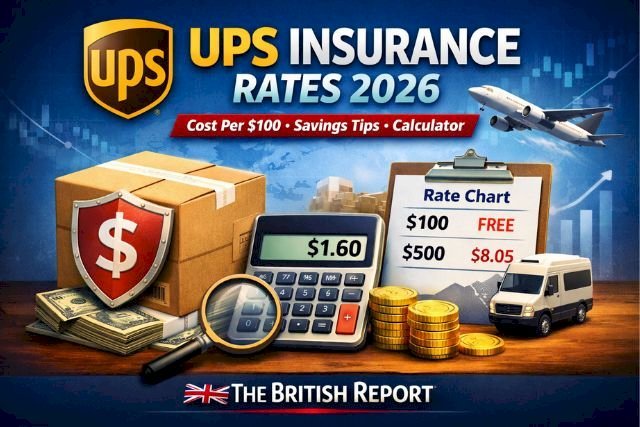
How to Calculate UPS Insurance Rates and Save Money on Shipping
Learn how UPS Insurance Rates are calculated, see real cost examples, rate charts, and expert tips to reduce shipping insurance costs while protecting valuable shipments.
UPS (United Parcel Service) offers shipping services that include options for insuring packages against loss or damage. Understanding UPS Insurance Rates is crucial for shippers looking to protect their goods and minimize costs.
UPS insurance is often preferred over third-party options due to its seamless integration with shipping services, faster claims processing, and reliability in covering lost or damaged shipments. While UPS provides automatic coverage for packages up to a certain value, knowing how to calculate additional insurance costs and exploring ways to save on shipping can be beneficial.
Why UPS Insurance Rates Matter for Businesses and Online Sellers
For e-commerce businesses and frequent shippers, understanding UPS Insurance Rates is not just about protecting packages—it’s about protecting profit margins.
Online sellers on platforms like eBay, Amazon, Shopify, and Etsy regularly ship products that may be worth hundreds or even thousands of dollars. Without proper insurance coverage, a single lost or damaged shipment could result in financial losses and customer dissatisfaction.
UPS declared value coverage allows businesses to ship confidently by ensuring compensation if something goes wrong during transit. While the default UPS coverage protects shipments up to $100, higher-value items require additional declared value charges.
For example, an online electronics store shipping a $1,200 laptop would pay additional UPS Insurance Rates to ensure the shipment is fully protected. If the package is lost or damaged, UPS may reimburse the declared value after reviewing the claim.
For businesses shipping hundreds of packages per month, calculating UPS Insurance Rates accurately helps maintain predictable logistics costs and reduce operational risks.
Understanding UPS Declared Value Coverage
UPS automatically covers packages up to $100 in value at no additional charge. If the declared value exceeds $100, extra charges apply. The cost structure for 2025 is as follows:
- For declared values between $100.01 and $300.00: A fee of $4.85 is applied.
- For declared values over $300.00: An additional charge of $1.60 per $100 (or a fraction thereof) is added to the base fee.
Example Calculation: For a package with a declared value of $500:
- The base fee for the first $300: $4.85
- Additional value over $300: $500 - $300 = $200
- Additional charge: ($200 / $100) * $1.60 = $3.20
- Total insurance cost: $4.85 + $3.20 = $8.05
It's important to note that the maximum declared value allowed varies depending on the shipment method and destination. For most shipments, the maximum is $50,000 when shipping with a UPS account number, but lower limits may apply in certain situations.
Calculating UPS Insurance Rates
To calculate the insurance cost for your UPS shipment:
- Determine the Declared Value: Assess the replacement value of the item being shipped.
- Apply for the Base Coverage: The first $100 of the declared value is covered at no additional charge.
- Calculate Additional Charges:
- For values between $100.01 and $300.00, add $4.85.
- For values over $300.00, add $4.85 plus $1.60 for each additional $100 or a fraction thereof beyond $300.
Example Calculation: For a package valued at $1,000:
- The base fee for the first $300: $4.85
- Additional value over $300: $1,000 - $300 = $700
- Additional charge: ($700 / $100) * $1.60 = $11.20
- Total insurance cost: $4.85 + $11.20 = $16.05
UPS Insurance Rate Chart (Estimated Cost Guide)
To better understand UPS Insurance Rates, it helps to look at a quick cost breakdown based on declared value. The table below shows approximate charges using the current UPS declared value pricing structure.
| Declared Value | Estimated Insurance Cost |
|---|---|
| $100 | Free |
| $200 | $4.85 |
| $300 | $4.85 |
| $500 | $8.05 |
| $1,000 | $16.05 |
| $2,000 | $32.05 |
| $5,000 | $80.05 |
This simplified UPS insurance rate chart helps businesses quickly estimate shipping protection costs before finalizing shipments. However, actual costs may vary depending on service type, destination, and special handling requirements.
For the most accurate UPS Insurance Rates, shippers should always verify prices through the official UPS shipping calculator.
UPS Insurance Rates for High-Value Shipments
Many businesses ship expensive items such as electronics, jewelry, designer fashion, or professional equipment. In these cases, understanding how UPS Insurance Rates scale with higher declared values becomes extremely important.
For shipments above $1,000, insurance costs can increase steadily depending on the declared value. However, the protection offered by UPS can provide peace of mind for businesses dealing with valuable merchandise.
Here are some estimated examples:
| Package Value | Estimated UPS Insurance Cost |
|---|---|
| $1,000 | $16.05 |
| $2,500 | $40.05 |
| $5,000 | $80.05 |
| $10,000 | $160.05 |
While these fees may seem significant, they represent a small percentage of the shipment’s value and can prevent major financial losses.
High-volume e-commerce companies often evaluate UPS Insurance Rates carefully and may combine declared value coverage with additional logistics strategies such as signature confirmation or improved packaging.
Factors Influencing UPS Insurance Rates
Several factors can affect the insurance rates for your UPS shipments, each influencing costs in different ways:
- Declared Value: Higher declared values result in increased insurance fees. For example, insuring a $1,000 package will cost $16.05, while a $500 package costs $8.05.
- Package Contents: Items like electronics or fragile goods may be subject to higher insurance rates due to increased risk of damage.
- Destination: Shipping to remote areas or international locations can incur additional fees due to higher risks of loss or damage.
- Shipping Service Selected: Expedited services like UPS Next Day Air may require higher insurance costs compared to standard UPS Ground, as quicker deliveries involve different handling processes and risks.
Understanding these factors can help shippers anticipate costs and make informed decisions when selecting insurance options.
UPS Declared Value vs Shipping Insurance: What’s the Difference?
Many shippers assume that UPS insurance and declared value coverage are the same thing. In reality, UPS technically offers declared value coverage, which sets the maximum liability UPS accepts if a package is lost or damaged.
Declared value allows UPS to determine compensation limits, but it does not function exactly like traditional insurance policies offered by third-party insurers.
Key differences include:
| Feature | UPS Declared Value | Third-Party Shipping Insurance |
|---|---|---|
| Coverage Provider | UPS | Insurance Company |
| Claims Process | Through UPS | Through insurer |
| Pricing | Fixed UPS rates | Often cheaper for bulk shippers |
| Coverage Flexibility | Limited | More customizable |
Businesses that ship expensive items frequently sometimes choose third-party insurance because it can reduce overall UPS Insurance Rates while still protecting valuable shipments.
Tips to Save Money on UPS Shipping
Reducing shipping costs while maintaining reliable service is a priority for many shippers. According to a 2024 survey by ShipStation, 73% of businesses reported that optimizing packaging and using discounted carrier rates helped them reduce shipping expenses by an average of 15%. Additionally, case studies from high-volume shippers indicate that negotiating rates with UPS can lead to annual savings of thousands of dollars, particularly for businesses shipping over 1,000 packages per month. Consider the following strategies:
- Open a UPS Account: Registering for a UPS account can provide access to shipping discounts and benefits, including free shipping supplies and scheduled pickups.
- Optimize Packaging: Use appropriately sized boxes to avoid dimensional weight charges. Proper packaging can also reduce the risk of damage, potentially lowering insurance costs.
- Compare Shipping Options: Evaluate different UPS services to find the most cost-effective option that meets your delivery requirements.
- Consider Third-Party Insurance: Third-party insurance providers may offer lower rates compared to UPS's declared value charges, especially for high-volume shippers.
- Negotiate Rates: High-volume shippers can negotiate discounted rates with UPS, leading to overall cost savings.
- Use Shipping Software: Utilizing shipping software can provide access to discounted rates and streamline the shipping process.
How Businesses Reduce UPS Insurance Costs
Large e-commerce businesses and fulfillment companies often use strategies to reduce their overall UPS Insurance Rates while maintaining shipment protection.
One common strategy is improving packaging quality. Well-packaged items are less likely to be damaged during transit, which can reduce claims and help maintain better carrier relationships.
Another strategy involves bundling shipping volume through a UPS account. Businesses that ship frequently can negotiate discounted shipping rates and sometimes benefit from lower declared value costs.
Companies also use shipping management platforms like ShipStation, Shippo, or EasyPost to compare rates, automate label creation, and track shipment data more efficiently. These tools help businesses evaluate insurance costs and optimize logistics decisions.
By analyzing shipment data over time, businesses can determine when paying UPS Insurance Rates is necessary and when lower-value shipments may not require additional protection.
Common UPS Insurance Claim Mistakes to Avoid
Even with UPS Insurance Rates paid, claims can sometimes be denied if proper procedures are not followed. Understanding common mistakes can help shippers avoid costly problems.
Some of the most frequent UPS insurance claim errors include:
Poor Packaging
UPS may deny claims if items were not packaged according to its guidelines. Fragile items should be double-boxed and properly cushioned.
Incorrect Declared Value
Declaring a lower value to save money on UPS Insurance Rates can backfire if the shipment is lost or damaged.
Missing Documentation
Receipts, invoices, and shipment details are often required during the claim process.
Late Claims Submission
UPS typically requires claims to be submitted within 60 days of delivery or expected delivery date.
Avoiding these mistakes ensures that your insurance protection actually works when you need it.
When Should You Pay for UPS Insurance?
Not every shipment requires additional declared value coverage. Understanding when to pay for UPS Insurance Rates can help businesses balance protection and cost.
Here are situations where purchasing additional UPS insurance is highly recommended:
Shipping Expensive Items
Products worth more than $100 should typically have additional coverage.
Shipping Fragile Goods
Electronics, glass items, and collectibles carry a higher risk of damage.
Shipping Internationally
International shipments involve more handling and longer transit times.
Shipping Business Inventory
Lost inventory can impact sales and customer satisfaction.
For inexpensive items, some businesses choose to accept the default UPS coverage instead of paying additional UPS Insurance Rates.
Using the UPS Shipping Calculator to Estimate Insurance Costs
The easiest way to estimate UPS Insurance Rates is by using the official UPS shipping calculator. This tool allows shippers to input package weight, destination, and declared value to calculate accurate shipping and insurance costs.
Steps to use the UPS calculator:
-
Visit the official UPS website.
-
Enter the package origin and destination.
-
Input the package weight and dimensions.
-
Add the declared value of the shipment.
-
Review the total shipping and insurance charges.
The calculator provides real-time estimates and helps businesses plan shipping expenses more accurately.
For frequent shippers, integrating UPS APIs or shipping software can automate these calculations and streamline logistics workflows.
Frequently Asked Questions
How much does UPS insurance cost per $100?
UPS typically charges $1.60 per $100 of value above $300, in addition to a base fee of $4.85 for declared values above $100.
Is UPS insurance worth it?
Yes, UPS insurance (declared value coverage) is worth it for shipments containing expensive, fragile, or business-critical items. It protects shippers from financial loss if packages are damaged or lost.
What is the maximum UPS insurance amount?
For most shipments, UPS allows a maximum declared value of $50,000 when shipping with a UPS account. Certain items or international shipments may have lower limits.
Can you insure packages through UPS after shipping?
No. UPS insurance must be declared at the time of shipment. Once the package has been processed, the declared value cannot be increased.
Conclusion
Calculating UPS insurance rates and implementing cost-saving strategies can significantly impact your shipping expenses. Shippers can make informed decisions by utilizing tools like the UPS Rate Calculator and exploring alternative insurance providers. For further guidance, refer to the official UPS Rate and Service Guide or consult industry resources on shipping cost management.
By assessing your shipping needs, exploring available options, and staying informed about current rates and policies, you can optimize your shipping processes and reduce costs effectively.
Read Also: Protective Life Insurance vs. Other Providers: Which One is Better?
alissaperry